
Alternator & generator repair, rewind and overhauls.
Workshop-grade repair for diesel generators and alternators — rewinding, top-end and full overhauls, fuel system and governor work.
- Rewinding
- Top-end overhaul
- Full overhaul
- Fuel & governor
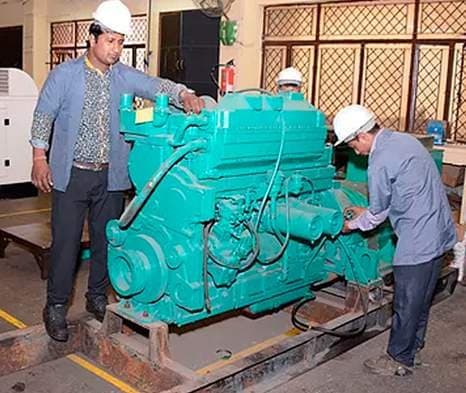
Where service ends and a real rebuild starts.
Routine service keeps a genset running well. Repair is what you need when something has failed — burnt windings, a dropped valve, a worn crank, fuel pumps that won’t hold pressure. The work needs a workshop, real metrology, and engineers who’ve done it before.
Our workshop handles alternator rewinding, top-end and full engine overhauls, injector pop testing, governor and AVR work — for diesel and gas gensets up to 2,000 kVA.
For routine maintenance and AMC mechanics, see service and AMC. If your genset is down right now, jump to breakdown response.
The repair scope, in detail.
Alternator rewinding
Full stator and rotor rewinding in our workshop. Insulation testing, winding to original spec.
Top-end overhaul
Cylinder head, valves, valve seats, injectors, head gasket. Genset usually back on load within 3–5 working days for mid-KVA jobs.
Full engine overhaul
Bottom-end + top-end. Crankshaft inspection, liners, pistons, rings, bearings — all rebuilt to original tolerances.
Fuel system & injectors
Injector pop testing, calibration, fuel pump rebuilding. We catch fuel-side issues that get misdiagnosed as engine wear and waste customers money.
Governor & control
Mechanical and electronic governor service, AVR replacement, control card diagnostics. Common cause of voltage / frequency drift.
On-site vs workshop
Most fixes happen on-site to minimise downtime. Anything needing a clean rebuild — rewinding, full overhaul, crank work — comes into the workshop where the right tools and conditions live.
Diagnosis → strip → measure → rebuild → test → handover.
Every rebuild starts with a written diagnosis — what failed, what's worn, and what we propose to do. The genset is then stripped down, components measured (clearances, ovality, insulation resistance), and either reconditioned or replaced.
Reassembly uses reliable parts only. After reassembly, the genset is run on load in our test bay and performance is logged.
Records carry across rebuilds. If we overhauled the same genset three years ago, the new engineer knows what was done and what to watch.
Frequently asked questions
Do you rewind generator alternators?
Yes — both stator and rotor. We maintain a dedicated rewinding section in the workshop. Insulation class is matched to the original.
Can you handle a full engine overhaul?
Yes. Top-end (head, valves, injectors, gaskets) and full overhaul (crank, liners, pistons, rings, bearings) are both handled in-house with reliable parts.
How do you decide between on-site and workshop repair?
On-site is the default — less downtime, no logistics. We come into workshop only when the work needs it: rewinding, crank or block work, anything requiring a clean environment or specialised tools. We tell you on the diagnosis call which path makes sense.
How long is the genset down for an overhaul?
Mid-KVA top-end: 3–5 working days. Full overhaul: 10–14 days assuming parts are in stock. We can sometimes provide a rental DG for the overhaul window — ask when scoping.
Looking for generator repair in your city?
On-site fixes for most cities; workshop rebuilds across NCR.
Need a rebuild scoped?
Tell us the make, KVA and symptom. We'll send a diagnosis engineer and quote the rebuild — workshop or on-site.